
Planned Expansion for Wildlife Hospital of Louisiana Aims to Bolster Education, Conservation, Protection, and Outreach
January 20, 2026
Every year, thousands of injured wild animals across Louisiana depend on the LSU School of Veterinary Medicine’s Wildlife Hospital for lifesaving medical care. From raptors struck by vehicles to turtles tangled in fishing lines, the hospital treats approximately 2,000 cases annually, with a release rate of about 73 percent for treatable patients. The goal is always the same: to heal, rehabilitate, and return these animals to their natural habitats.
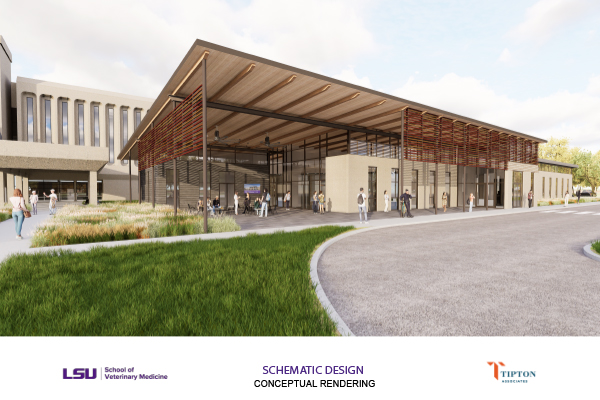
An architectural rendering of a new Wildlife Hospital of Louisiana shows the building’s planned design and positioning on the LSU Vet Med campus.
But the need has far outgrown the space. The Wildlife Hospital of Louisiana is currently confined to a mere 350 square feet inside the LSU Veterinary Teaching Hospital. With few upgrades in more than four decades, the facility is stretched far beyond its limits.
“By the end of July 2025, we had already surpassed the number of injured wildlife cases presented in 2024, a more than 40% increase in caseload,” explained Dr. Mark Mitchell, professor of zoological medicine and head of the Wildlife Hospital. “The new Wildlife Hospital of Louisiana will provide us much needed space to meet the growing demands of injured wildlife in Louisiana.”
Plans are in progress for a new, stand-alone Wildlife Hospital of Louisiana—an ambitious project that represents a momentous step forward in LSU Vet Med’s history. Designed to reflect LSU’s position at the forefront of wildlife healthcare and conservation medicine worldwide, the new facility will not only expand medical capacity but also enhance education, research, conservation, protection, and community outreach.
The planned Wildlife Hospital will include induction and recovery rooms, operating suites, ICU wards, a radiology suite with advanced diagnostic imaging, species-specific areas for mammals, reptiles, raptors, and waterfowl, a clinical research laboratory, an auditorium, and classrooms for public education. Visitors will be able to engage with interactive exhibits, while students and professionals will benefit from conference and rounds rooms, offices, and dedicated teaching spaces.
“This building will allow us to bring school children to our facility. It will give us the capacity to take care of all species of wildlife,” Dr. Mitchell said. “Right now, we’re limited in what we can take because of our small size. With conservation and protection, we help with screening for diseases. For example, we identified several cases of West Nile Virus in birds before it was even detected in mosquitoes. With the new hospital, we could test every bird, in house, and use it to train our students.”
The educational impact is significant. The facility will host Louisiana high school and college students, offering interdisciplinary opportunities that incorporate veterinary medicine.
“We want to give students a chance to apply biology, math, chemistry, and physiology, and other academic areas in a real-world setting,” Dr. Mitchell said. “With a living animal, I can show them how nutrition, case management, and calculating doses work together. In addition, biological engineering students could design and 3D-print a plate that goes into an injured bald eagle. Future doctors can experience surgery firsthand. Students from different backgrounds will teach and mentor one another. This can be a powerful recruiting tool to keep Louisiana’s brightest students here.”
The Wildlife Hospital will also serve as a center for One Health research, connecting animal health with environmental and human health. Through conservation science, disease surveillance, and public education, LSU Vet Med envisions the hospital as a hub for protecting Louisiana’s most treasured resource—its wildlife. The impact for Louisiana will be profound.
“This new facility will expand our capacity not only to provide medical and surgical services for injured wildlife but also to train students at every level, from high school to graduate school,” Mitchell said. “Our goal is to incorporate education, conservation, and protection on a scale we’ve never had before.”
Now in the fundraising stage, the Wildlife Hospital of Louisiana represents more than a new building. It is a commitment to the state’s wildlife, a dedication to education and innovation, and a promise to future generations. With support, LSU Vet Med is poised to set a new global standard in wildlife care—right here in Louisiana.
Those who are interested in supporting the Wildlife Hospital initiative may contact Tracy Evans, MPA, assistant vice president of development, LSU Foundation, at tevans@lsufoundation.org.