


Before Dawn in Baton Rouge, LSU Team Captures Space Images of Artemis II in Action
April 08, 2026
As Artemis II hurtled through space away from Earth, a group of LSU students and faculty led by Eric Borowski, a graduate student of Physics & Astronomy in LSU's College of Science, watched in awe and wonder from Baton Rouge.
From inside the Highland Road Park Observatory (HRPO), they documented the event with images of Artemis II, approximately 75,000 miles from Earth and a third of the way to the moon.
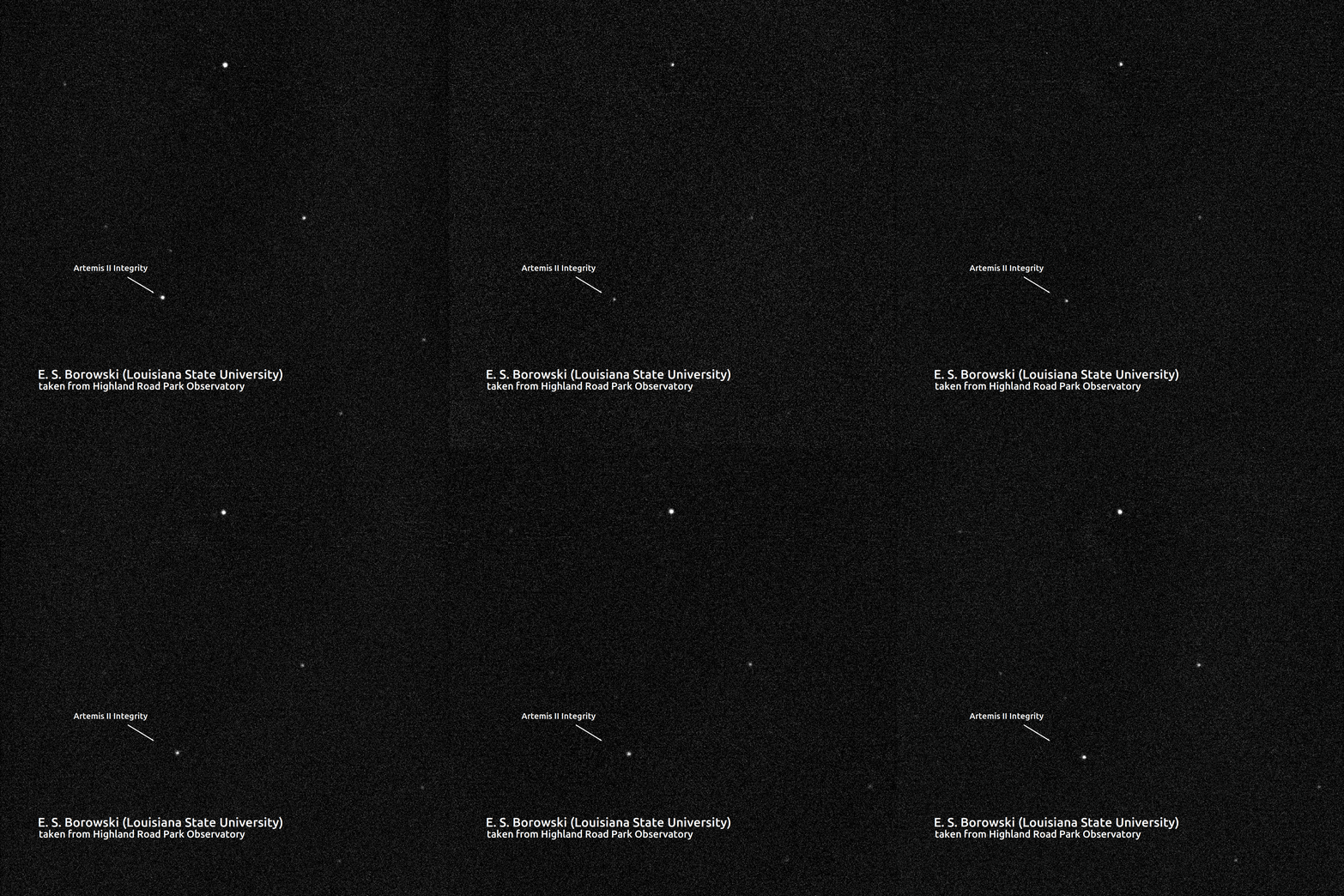
An animated GIF, made from images taken over 1.5 minutes from the Highland Road Park Observatory telescope in Baton Rouge, shows Artemis II moving in space approximately 75,000 miles from Earth.
– Eric Borowski
Borowski arrived at HRPO at 2 a.m. and operated HRPO’s telescope, fighting through clouds to try to catch Artemis II in action.
“We spent the next three hours alternating between looking at the moon, which can still be seen through moderate cloud cover, and pointing the telescope at the current position of the spacecraft to try to catch it in between clouds,” Borowski said.
To find the spacecraft, Borowski used an online solar system data and ephemeris computation service called JPL Horizons, maintained by NASA's Jet Propulsion Laboratory.
“This turned the telemetry data of the spacecraft and our location on the Earth into sky coordinates, so I knew where to point the telescope,” Borowski said.
Finally, the work and patience paid off.
“Eventually, around 5:15 a.m., the clouds cleared enough to take another crack at finding the spacecraft, and I captured the images in the animation,” Borowski said. “The buildup of hours of effort and disappointment turned instantly into excitement, and we all cheered and clapped as the images popped up on the computer screen.”
The images compiled over 1.5 minutes show what looks like a dot of light, which is the sunlight reflecting off a spacecraft the size of a room, from nearly 75,000 miles away, and traveling at 23,000 miles per hour.
“The quickest comparison I can think of is that this (distance) is three times the circumference of Earth,” said Eric Burns, associate professor of Physics & Astronomy in LSU's College of Science.
The experience inside the observatory brought the momentous event that, while thousands of miles away, was delivered right to Baton Rouge and directly to their LSU education.
“The excitement we all shared felt childlike, and I feel so lucky to have been able to see it! I think Artemis II has reignited excitement about the moon, and I hope it sticks around,” said Emery Jones, an undergraduate student majoring in computer science.